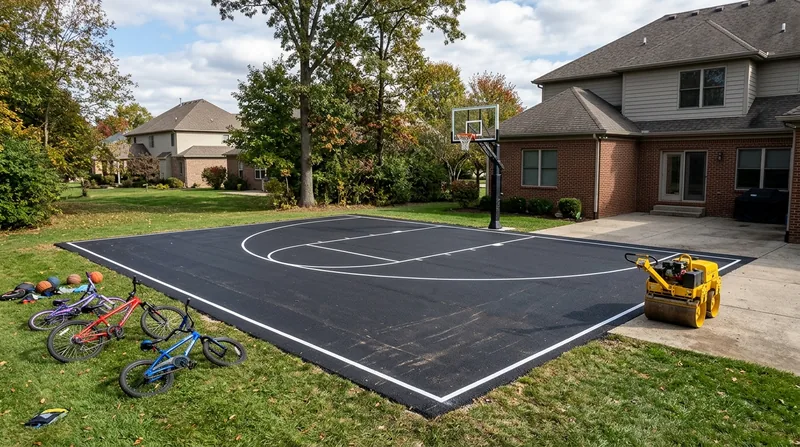




Backyard courts and recreational paths in Lexington demand more than casual grading. Basketball courts, tennis pads, pickleball bases, and walking trails need sports court and path paving built to exacting flatness tolerances and durable through the freeze-thaw cycles that crack ordinary residential driveways every winter. The Bluegrass region's shallow limestone base, 47 inches of annual rain, and ice storms that cycle in and out from November through March create conditions where a surface that is off by a quarter-inch or lacks proper base structure will fail within two to three seasons. We build asphalt courts and paths with tight-tolerance surface courses that stay true for acrylic color systems, proper drainage, and the structural depth needed to handle the weight and movement of recreational traffic without cracking or settling. Whether you are adding a court to a Meadowthorpe estate, a path system on a horse farm in Versailles, or a golf cart trail on a private road in Scott County, the pavement must be flat, stable, and built to last.
Why Sports Court and Path Paving Matters in Lexington's Residential and Rural Landscape
Lexington and the surrounding Inner Bluegrass are home to thousands of private estates, horse farms, and residential communities where recreational courts and pathways are expected features. The region's rich phosphatic silt loam and underlying Ordovician limestone create drainage challenges that generic gravel or poorly compacted asphalt cannot handle. Freeze-thaw damage, subsurface settling from karst sinkholes, and the weight of regular foot and equipment traffic demand a properly engineered asphalt structure from the base up.
- We install basketball and tennis court pads with dead-flat surfaces that meet the tolerance standards required for acrylic color systems and professional play.
- We build walking paths and recreational trails with proper crown and drainage to shed the heavy seasonal rainfall without ponding or undermining the edges.
- We prepare golf cart trails on private roads and estates with compacted base layers that handle year-round traffic without rutting or cracking.
- We use full-depth asphalt design with proper stone base and proof rolling to prevent the settling and frost heave that plague thin overlays in central Kentucky.
Proper sports court and path paving prevents costly repairs and keeps recreational surfaces playable through the region's harsh winters.
Key info: Lexington's freeze-thaw cycle runs from November through March, with ice storms and temperature swings that crack pavement built without adequate base preparation. A court or path installed with a shallow or improperly compacted base will show alligator cracking and surface failure within one to two winters. Full-depth design, not overlay, is the standard for sports and recreational surfaces in the Bluegrass.
For more on how base preparation and structural design affect long-term durability, see our guide to asphalt resurfacing and overlay decisions in Lexington.
How We Build Sports Court and Path Paving in Lexington: Our Process
Every court and path project begins with a site visit to assess drainage, soil conditions, and the intended use. We measure the area, evaluate the subgrade, and design a base structure that will support the surface and handle Lexington's wet winters without settling or cracking. We compact the stone base in lifts, proof roll to verify support, and then place the asphalt surface in a single or double lift depending on the thickness required.
- We conduct a site walkthrough to identify drainage patterns, soil type, and any utilities that must be marked before excavation.
- We remove existing pavement or grade the subgrade to the proper elevation, sloping for drainage toward catch basins or away from structures.
- We deliver and compact stone base material in 6-inch lifts, with proof rolling between each lift to verify bearing capacity and prevent future settling.
- We place the asphalt surface in a single or double lift, finishing the top course to dead-flat tolerance using stringlines and laser levels.
- We allow proper curing time before the court is marked or equipment is moved onto the surface.
The result is a court or path that will handle seasonal stress and regular use without cracking or surface failure.
Example: A residential basketball court in Meadowthorpe requires 4 inches of compacted stone base and 2 inches of asphalt to handle the weight of players and equipment. A walking path on a horse farm near Versailles may need 3 inches of base and 1.5 inches of asphalt if foot traffic only is expected. A golf cart trail on a private road in Scott County handling regular cart traffic needs 6 inches of base and 2 inches of asphalt. We size the structure to the use, not to a generic standard.
For details on our approach to private roads and estate work, see private road and HOA paving.
| Surface Type | Typical Base Depth | Asphalt Thickness | Best for |
|---|---|---|---|
| Basketball or tennis court | 4 to 6 inches compacted stone | 2 inches total | Residential or light-commercial play surfaces requiring dead-flat finish |
| Pickleball court or walking path | 3 to 4 inches compacted stone | 1.5 inches total | Foot traffic and light recreational use on residential properties |
| Golf cart trail or light-duty road | 5 to 6 inches compacted stone | 2 to 2.5 inches total | Regular wheeled traffic on private estate or farm roads |
| Heavy-use recreational or parking area | 6 to 8 inches compacted stone | 2.5 to 3 inches total | Mixed foot and vehicle traffic, seasonal freeze-thaw stress |
Sports Court and Path Paving Cost in Lexington: What to Expect
The cost of a sports court or recreational path depends on the size of the area, the depth of base preparation required, site access, and local soil and drainage conditions. A residential basketball court typically runs from $8,500 to $12,000 depending on whether existing pavement must be removed and how much grading is needed. A walking path or golf cart trail on an estate can range from $6,000 to $15,000 or more depending on length and terrain. Getting a written estimate on site is the only way to know the real cost for your project, because the stone base depth, tonnage, and labor are all driven by what the ground actually is.
- We measure the area and evaluate soil conditions to determine the required base depth, which is the largest cost driver.
- We account for site access, equipment staging, and whether existing pavement or structures need removal or relocation.
- We provide a written estimate with tonnage, thickness, and labor itemized so you know exactly what the cost covers.
- We explain any factors that could increase the cost, such as poor drainage, rock outcrops, or utility locates that require rerouting.
Honest pricing means getting two or three estimates from local contractors and comparing the base depth and tonnage, not just the total dollar figure. For a detailed pricing overview, see our full pricing guide.
Sports Court and Path Paving Near Me: What to Look for When Hiring a Contractor in Lexington
Hiring a paving contractor for a court or path is a significant decision, and the contractor you choose will determine whether the surface stays flat and durable or fails within a few seasons. Look for a contractor with a local address and local equipment who can explain the base design and tonnage in writing. Verify that the contractor is fully insured, get references from past court and path projects in the area, and ask how they handle drainage and base preparation in Lexington's limestone and clay soils.
- Ask for a written estimate that includes the stone base depth, asphalt thickness, and total tonnage so you can compare apples to apples with other bids.
- Request references from three or more court or path projects completed in Lexington, Georgetown, or Nicholasville in the past two to three years.
- Verify that the contractor is fully insured and can provide a certificate of insurance before work begins.
- Ask how the contractor will handle drainage and whether a permit is required for your specific project, then verify the answer with the Lexington Planning and Development Services.
- If your property is in an HOA community, confirm that the contractor understands HOA architectural standards and will submit drawings for approval if required.
- Avoid contractors who offer a price over the phone without a site visit, who ask for a large cash deposit, or who promise a lifetime warranty on asphalt.
A local contractor with a track record of court and path work in the Bluegrass will give you the honest guidance you need. Contact us for a free estimate and let us walk you through the process.
Sports Court & Path Paving in Lexington: Pricing Guide
| Service | Price | Details |
|---|---|---|
| Residential basketball or tennis court | Starting at $8,500 | Includes 4 to 6 inches of compacted stone base and 2 inches of asphalt finish, dead-flat tolerance |
| Walking path or pickleball court | Starting at $6,000 | Smaller area with 3 to 4 inches of base and 1.5 inches of asphalt, foot traffic only |
| Golf cart trail or light-duty private road | Starting at $10,000 | Longer length or mixed foot and wheeled traffic, 5 to 6 inches base and 2 to 2.5 inches asphalt |
| Large or complex project | On estimate | Heavy-use areas, drainage challenges, utility relocates, or terrain requiring custom base design |
| Free estimate | No obligation | Site visit, measurement, soil assessment, and written bid within 24 hours at (859) 710-8221 |
Indicative pricing, the exact cost depends on square footage, finish, and site access. Free personalized estimate within 24h at (859) 710-8221.


