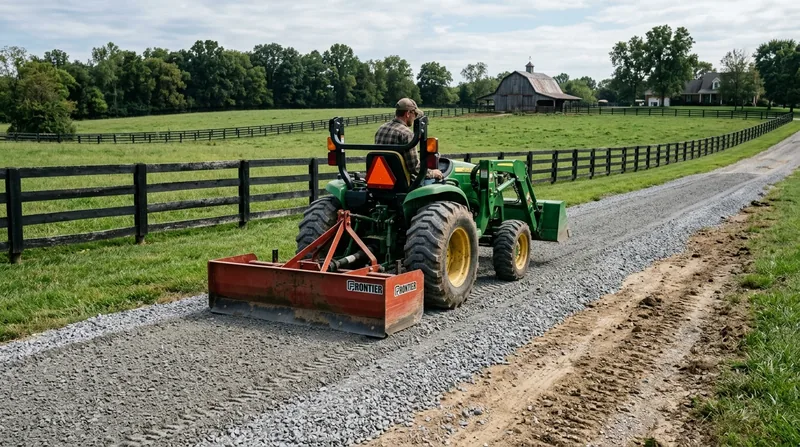




Central Kentucky's rolling horse country and suburban Lexington depend on reliable driveways and lanes. The Gravel Driveway Installation & Grading work we do keeps rural properties, private roads, and transitional drives functional through the region's heavy spring runoff, freeze-thaw winters, and hot summers. The ground here is rich phosphatic silt loam over shallow Ordovician limestone riddled with karst sinkholes that swallow runoff and undermine weak bases. Proper grading and dense-graded aggregate built in lifts is the foundation of every durable drive, whether it stays gravel or becomes the base for future asphalt. We build the base once and correctly, so that when you're ready to pave, the work holds.
Why Gravel Driveway Grading Matters on Lexington's Karst Terrain
Lexington and the surrounding horse country sit on limestone that collapses from below. Spring rains, nearly 47 inches annually, drain fast through sinkholes rather than across the surface, leaving weak spots and soft bases that settle under vehicle weight. A gravel drive without proper crown, drainage, and base preparation fails in one season. Good grading is not cosmetic; it is the engineering that keeps a lane from washing out every April or settling into ruts by July.
- We establish proper crown and slope to shed water away from the drive centerline and toward stable ground.
- We remove soft material and replace it with dense-graded aggregate compacted in lifts, not dumped in one heap.
- We identify karst risk and reroute drainage or strengthen the base where sinkholes are known.
- We proof-roll the finished base so you know the drive will carry traffic without settlement.
A well-graded gravel drive lasts five to seven years with light maintenance. A poorly graded one fails in one wet season.
Key info: Horse farms in Versailles and Frankfort, private roads in Georgetown, and rural properties in Richmond and Winchester all depend on proper grading. We also regrade existing lanes that have washed out or settled, crowning them and filling potholes before the next spring rain cycle. Grading is the first step of every future paving job, so investing now saves money later.
For more on how we prepare bases for future paving, see our Asphalt Driveway Paving & Installation page.
How We Install and Grade Gravel Driveways in Lexington
Every new gravel drive we build starts with a site walk. We measure the length and width, identify drainage patterns, check for sinkholes or soft ground, and look at where water naturally wants to go. Then we plan the crown, the base thickness, and the aggregate type. We do not guess, and we do not use leftover material from another job.
- We mark the drive centerline and establish the proper slope (typically 2 to 4 percent crown from center to edge).
- We remove unsuitable material (clay, organic topsoil, or soft silt) down to firm ground.
- We lay geotextile fabric to separate the base aggregate from the subgrade and prevent mixing.
- We place dense-graded aggregate in three to four lifts, compacting each one with a vibratory roller.
- We finish with a wearing course of smaller stone sized to lock together and shed water.
- We grade the drive to proper crown and tie drainage into stable ground or existing ditches.
The whole job takes one to three days depending on length and width. You can use the drive immediately, though it will settle slightly over the first month as traffic compacts it.
Local example: A 200-foot private lane in Nicholasville that was rutted and washing out got regraded with four inches of compacted base and a two-inch wearing course. Cost was in the $2,800 range. The same drive in Georgetown with deeper soft ground and karst risk required base removal and replacement, bringing the total to $4,200. Both drives are now stable and ready to support asphalt when the owner is ready to pave.
For more on full-depth base preparation and future paving, see our Asphalt Resurfacing & Overlay page.
Gravel Driveway Methods and Materials
| Approach | Description | Best for |
|---|---|---|
| New Gravel Drive Installation | Fabric base with three to four lifts of dense-graded aggregate, compacted and crowned. | New drives on stable ground, private lanes, rural properties, or temporary access roads. |
| Regrading and Pothole Repair | Remove soft material, reestablish crown, fill washouts, and compact new aggregate into failed sections. | Existing gravel drives that have settled, rutted, or washed out; spring maintenance after heavy runoff. |
| Karst-Risk Base Preparation | Deeper excavation, subgrade stabilization, and thickened aggregate base over known sinkhole risk zones. | Lexington limestone areas with karst subsidence; horse farms and private roads where base failure is costly. |
| Recycled Asphalt Millings Drive | Compacted recycled asphalt (RAP) in place of virgin stone; hardens over time and sheds water. | Budget-conscious owners; transitional surfaces before paving; environmentally conscious property managers. |
| Tar and Chip Surface | Recycled asphalt or stone bound with liquid asphalt, rolled smooth; looks like asphalt but is gravel. | Heritage properties, HOA restrictions on full asphalt, rural aesthetic, or budget between gravel and paving. |
Each method is quoted on site after we measure and assess the ground. Dense-graded aggregate and proper compaction are the common thread; the difference is depth, material type, and intended lifespan.
Gravel Driveway Installation & Grading Cost in Lexington: What to Expect
A new gravel drive in Lexington starts at $950 to $1,200 for a short residential approach (roughly 50 feet by 12 feet) with standard dense-graded aggregate and proper grading. Longer drives, deeper preparation, karst stabilization, or recycled asphalt material will move the price up. A 200-foot private lane with standard base runs $2,500 to $3,500. A rural property with soft ground and known sinkhole risk can reach $4,500 to $6,000 or more.
Cost depends on these factors:
- Length and width of the drive (measured in square feet or linear feet for lanes).
- Depth of excavation required (soft material removal adds time and dump fees).
- Material type (virgin dense-graded stone, recycled asphalt, tar and chip, or specialty aggregate).
- Crown and drainage complexity (simple slope is cheaper than rerouting water around sinkholes).
- Access and compaction equipment (tight driveways or narrow rural lanes may require smaller equipment and more hand work).
We provide a written estimate with tonnage, depth, and material type specified. The price does not change unless you request a change. We encourage you to get two or three estimates from local contractors so you can compare scope and material. For detailed pricing across all our services, see our Pricing page.
Gravel Driveway Installation & Grading Near Me: What Lexington Homeowners Should Know
When you hire a contractor for gravel work, verify that they are fully insured and can show you proof of coverage. Ask for references from recent jobs in your neighborhood (Chevy Chase, Ashland Park, Meadowthorpe, or the surrounding rural areas). Understand what the estimate includes: material type, tonnage, depth, compaction method, and whether regrading or subgrade removal is part of the scope. Ask about drainage and how water will be handled. If your drive is in an HOA community, check the architectural standards; some HOAs restrict gravel and require tar and chip or asphalt. If you are planning a future paving job, tell the contractor now so the base can be built to support asphalt later.
Avoid contractors who offer unsolicited door-to-door estimates, demand a large cash deposit, have out-of-state plates, or quote a price without measuring and walking the site. Get everything in writing, including material specs and tonnage. Verify that the contractor is familiar with Lexington's limestone terrain and karst drainage; a contractor who has only worked in flat, stable ground may not account for local risk.
For a free, no-obligation estimate and to discuss your specific drive, call us at (859) 710-8221 or visit our Contact page. We have been in business since 2011 and serve Lexington, Georgetown, Nicholasville, Richmond, Winchester, Versailles, Frankfort, and the surrounding Inner Bluegrass.
Gravel Driveway Installation & Grading in Lexington: Pricing Guide
| Service | Price | Details |
|---|---|---|
| Residential gravel drive (50-75 ft) | Starting at $950 | New installation with dense-graded base and proper crown; soft material removal adds cost |
| Private lane or long driveway (150-250 ft) | Starting at $2,500 | Multiple lifts of compacted aggregate, regrading, and drainage; karst preparation increases price |
| Regrading and pothole repair (existing drive) | Starting at $1,200 | Crown restoration, soft spot removal, and new wearing course; extent of washout determines final cost |
| Recycled asphalt millings or tar and chip | Starting at $1,100 | Material cost varies; recycled asphalt is lower than virgin stone; tar and chip costs more than gravel alone |
| Karst-risk base stabilization | On estimate | Deeper excavation, subgrade treatment, and thickened base for sinkhole-prone limestone terrain requires site assessment |
| Free estimate and site visit | No charge | Written estimate with tonnage, depth, and material specs; response within 24 hours, no obligation to book |
Indicative pricing, the exact cost depends on square footage, finish, and site access. Free personalized estimate within 24h at (859) 710-8221.


